Local SEO for Small Businesses: The Complete Guide to Ranking in Your Area (2026)
Learn how small businesses climb Google's local pack and Maps rankings. A step-by-step local SEO guide covering GBP, citations, reviews and schema.
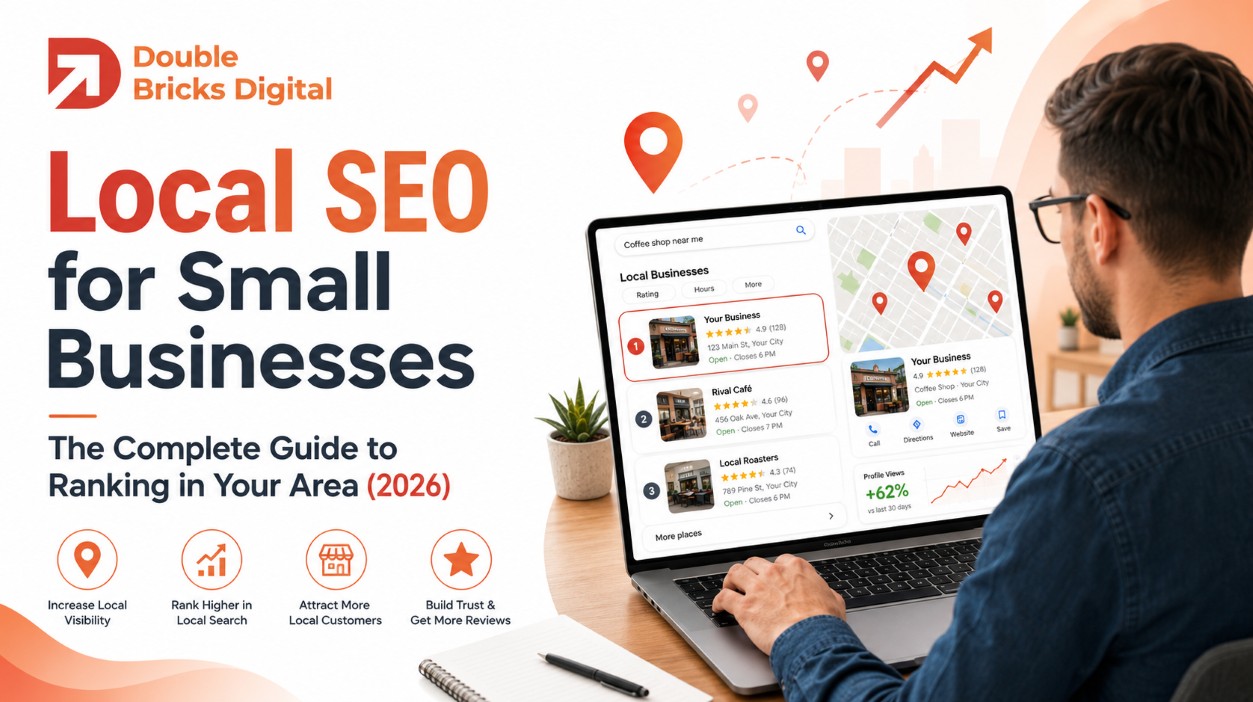
If someone in your suburb searches for what you sell right now, does your business show up — or does a competitor?
Local search has become the front door to most small businesses. Nearly half of all Google searches carry local intent, and the large majority of people who search for something "near me" visit or contact a business within 24 hours of searching. That's about as close to a customer standing in your doorway with their wallet out as marketing gets. The problem is that most small businesses aren't set up to be found in that moment — one widely cited industry estimate puts the number of businesses with no real local SEO plan at well over half.
This guide walks through exactly what local SEO is, the ranking factors Google actually uses, and the step-by-step work involved in showing up when your next customer searches. It's written for owner-operators and marketing managers at small and medium businesses, not for other SEOs — so expect plain language over jargon.
What Is Local SEO (And How It's Different From Regular SEO)
Local SEO is the practice of optimising your online presence so your business appears in location-based searches — things like "plumber Epping," "dentist near me," or a plain "cafe" search from someone standing two streets away. It overlaps with traditional SEO, but it has its own ranking system, its own real estate on the search results page (the "local pack" — the map and three business listings that appear above the standard organic results), and its own set of levers, the biggest of which most businesses have never touched: their Google Business Profile.
If you serve customers in a defined geographic area — a shopfront, a service area, a clinic, a showroom — local SEO isn't a nice-to-have. It's usually the highest-return channel available to you, because the person searching is often ready to buy, not just browsing.
The 3 Factors Google Uses to Rank Local Results
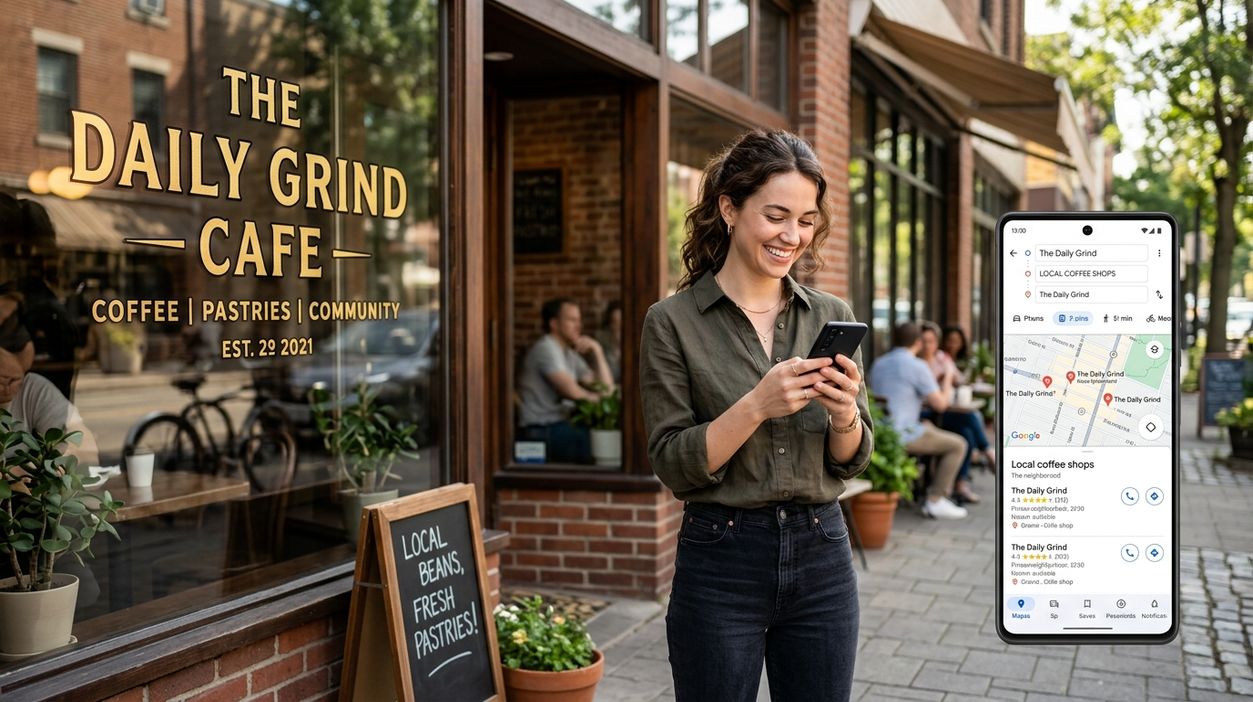
Google has confirmed that local rankings come down to three factors. Every recommendation in this guide maps back to one of them.
Relevance — how well your business profile and website match what the searcher is looking for. This is about having the right categories, the right services listed, and content that clearly describes what you do.
Distance — how far your business is from the location implied in the search (or the searcher's actual location, if they haven't specified one). You can't move your premises to win this one, but you can make sure Google has accurate location data and that you're not accidentally targeting the wrong area.
Prominence — how well-known and well-regarded your business is, both online and off. Reviews, citations, backlinks, and general brand signals all feed into this.
You can't control distance. You have significant control over relevance and prominence — and that's where the rest of this guide is focused.
Step 1: Get Your Google Business Profile Right
Your Google Business Profile (GBP) is the single biggest lever in local SEO. If you only do one thing after reading this article, do this.
- Claim and verify it. Sounds obvious, but a surprising number of small businesses are still working from an unclaimed or unverified listing, which caps how often Google will show it.
- Choose the most specific primary category available, not the broadest one that technically applies. "Italian Restaurant" beats "Restaurant." "Family Lawyer" beats "Lawyer." Add secondary categories for everything else you genuinely offer.
- Write a complete business description using your primary service and location naturally — not stuffed with keywords, just clearly written for the humans who'll read it.
- List every individual service as its own entry with its own short description, rather than one paragraph covering everything.
- Upload photos regularly. Profiles with strong, current photo galleries consistently see more direction requests and click-throughs than sparse ones — aim for at least 10 to start, and add new ones monthly.
- Post updates weekly. GBP posts (offers, news, events) are a ranking and engagement signal most competitors ignore, which makes them a relatively easy edge.
- Seed and answer your Q&A section. Add the questions customers actually ask you, and answer every public question that comes in.
Step 2: Fix Your NAP Consistency & Citations
NAP stands for Name, Address, Phone — and it needs to be identical, character for character, everywhere your business is listed online: your website, your GBP, Facebook, industry directories, everywhere. Inconsistencies (a missing suite number here, an old phone number there) fragment the trust signals Google uses to confirm you're a real, stable business.
Search your business name plus your suburb to see what's already out there, then work through the priority list:
- Tier 1 (do these first): Google Business Profile, Bing Places, Apple Business Connect, Facebook Business Page, Yellow Pages, True Local
- Tier 2 (industry-specific): directories relevant to your field — health, legal, trades, and hospitality all have their own high-value niche directories worth claiming
- Tier 3: local council directories and Chamber of Commerce listings, which double as low-effort local link building
Step 3: Build Local Signals Into Your Website
Your Google Business Profile does a lot of the heavy lifting, but your website still needs to back it up.
If you serve more than one suburb or region, each one deserves a genuine, unique page — not a templated page with the suburb name swapped out. Include your target suburb naturally in the title tag, H1, first 100 words, and at least one subheading. We've built dedicated local pages for our own service areas, including Craigieburn and Epping — worth a look as a working example of the structure.
You should also add LocalBusiness schema markup to your site. This is structured data that explicitly tells Google (and increasingly, AI systems) your business name, address, phone, hours, and service area, rather than leaving it to infer that from your page copy. Here's a working example:
{
  "@context": "https://schema.org",
  "@type": "LocalBusiness",
  "name": "Your Business Name",
  "url": "https://www.yourbusiness.com.au",
  "telephone": "+61-X-XXXX-XXXX",
  "address": {
    "@type": "PostalAddress",
    "streetAddress": "Your Street Address",
    "addressLocality": "Your Suburb",
    "addressRegion": "VIC",
    "postalCode": "XXXX",
    "addressCountry": "AU"
  },
  "openingHoursSpecification": [
    {
      "@type": "OpeningHoursSpecification",
      "dayOfWeek": [
        "Monday",
        "Tuesday",
        "Wednesday",
        "Thursday",
        "Friday"
      ],
      "opens": "09:00",
      "closes": "17:00"
    }
  ],
  "image": "https://www.yourbusiness.com.au/logo.jpg",
  "priceRange": "$$",
  "areaServed": {
    "@type": "City",
    "name": "Melbourne"
  }
}
Swap LocalBusiness for the most specific subtype available for your industry — Dentist, LegalService, HomeAndConstructionBusiness, and dozens of others exist and give Google more precise signals than the generic type. Not sure yours is set up correctly? Our free schema audit tool will check what's currently on your site and flag what's missing.

Step 4: Win More (And Better) Reviews
Reviews influence both rankings and conversions — they're doing double duty. The large majority of consumers say they read reviews before choosing a local business, and profiles with more recent, higher-volume reviews consistently outperform sparser ones in the local pack.
A few rules that matter more than people expect:
- Ask at the right moment — right after a good experience, not in a generic monthly email blast.
- Make it frictionless. A direct GBP review link removes almost every excuse not to.
- Never incentivise reviews. It's against Google's guidelines and puts your whole profile at risk.
- Respond to every review, positive and negative. A calm, professional response to a bad review often does more for your credibility than the review itself does damage.
- Aim for steady velocity — a handful of new reviews most months, rather than a suspicious burst followed by silence.
Step 5: Earn Local Links
Links from other reputable local websites signal prominence in a way almost nothing else can fake. The highest-value sources are usually the most overlooked:
- Local news coverage and sponsorship pages
- Industry association member directories
- Local council and community resource pages
- Sports clubs, charities, and community events you sponsor
- Genuine supplier or partner relationships
Skip generic paid directory submissions — they add citation clutter without adding real authority, and in some cases can do more harm than good.
The AI Search Shift: Why Local SEO Now Includes AI Overviews
One thing has changed meaningfully in the last two years: a large and growing share of local searches now trigger an AI-generated overview at the top of the page before any traditional results appear, and a growing number of people are asking ChatGPT and similar tools for local business recommendations directly. That doesn't replace the fundamentals above — Google Business Profile, reviews, and citations are still doing most of the work — but it does raise the bar on how clearly your website content answers real customer questions. We've written a separate, deeper guide on this shift if you want to go further: Decoding AEO, SEO, GEO & LLM.
7 Local SEO Mistakes We See Small Businesses Make
- Keyword-stuffing the GBP business name (this breaches Google's guidelines and risks suspension)
- Leaving the GBP Services section empty or half-filled in
- Inconsistent NAP details between the website and directory listings
- Thin, templated location pages that only swap the suburb name
- No schema markup at all, or copy-pasted schema that doesn't match what's actually on the page
- Letting review requests happen randomly instead of building it into your process
- Treating local SEO as a one-off project rather than ongoing maintenance
How Long Does Local SEO Take to Work?
Quick wins — GBP fixes, schema, and NAP corrections — can move the needle within a couple of weeks. Citation building and review momentum typically take one to three months to compound. Meaningful, durable ranking improvement is more commonly a six-to-eight month arc, which is roughly what we tell our own clients to expect and why we report progress monthly rather than promising overnight results.
If you're weighing local SEO against paid search for faster results, our comparison guide is worth reading: SEO vs PPC: What's Right for Your Business?
Getting Local SEO Help From a Team That Lives This Every Day
Double Bricks Digital is a Melbourne-based digital marketing team that's been doing this work for small and medium businesses for over a decade — Google Ads Search Certified, 100+ clients, and a habit of explaining what we're doing in plain English rather than jargon. One Melbourne bakery client saw a 200% increase in online orders after we rebuilt their local SEO and content strategy — you can read that story and others in our case studies.
If you'd rather have a specialist team handle the local SEO work in this guide instead of doing it yourself, our Search Marketing (SEO/SEM) service covers everything above, tailored to your industry and area. Get in touch and we'll take a look at your current local presence and tell you honestly where the gaps are.
Frequently Asked Questions
Do I need a physical storefront to do local SEO?
No. Service-area businesses (trades, mobile services, consultants) can still rank locally — you set a service area in your Google Business Profile instead of displaying a public address, and suburb-specific landing pages become even more important.
How much does local SEO cost for a small business?
It varies widely depending on how competitive your industry and area are and how much of the work — citations, content, review systems — needs building from scratch. There's no one-size-fits-all number, which is why we scope every engagement around the specific business rather than selling a fixed package.
Can I do local SEO myself, or do I need an agency?
The fundamentals in this guide are genuinely doable in-house, particularly the GBP setup. Where businesses usually run out of time (not ability) is the ongoing citation building, content, and review management — the ongoing maintenance rather than the initial setup.
Does local SEO work for multi-location businesses?
Yes, but each location needs its own Google Business Profile and its own genuinely unique website page — not a templated page with the suburb swapped. We cover multi-location nuances for specific industries, including our dedicated dental marketing work, where multi-practice groups are common.