Schema Markup for AI Search: How to Get Cited by Google AI Overviews and ChatGPT (2026 Guide)
Does schema markup really help you get cited by AI Overviews and ChatGPT? A practical, honest 2026 guide to structured data for AI and Google search.
Somewhere in the last two years, "will this rank on page one" stopped being the only question that mattered. Now there's a second one: will an AI Overview, ChatGPT, or Perplexity actually cite your business when someone asks a question you could answer? Schema markup gets pitched constantly as the fix for that — add the code, get cited. It's worth being honest about what schema actually does before you spend a weekend implementing it for the wrong reason.
This guide covers what schema markup is, which types are actually worth implementing in 2026, how to add it to your site, and — importantly — what the evidence really shows about its effect on AI citations versus traditional search.
What Is Schema Markup, in Plain English
Schema markup (also called structured data, usually written in a format called JSON-LD) is a small block of code added to a webpage that explicitly labels what the content on that page means. Instead of making Google guess whether a page is a recipe, a product, a local business, or an FAQ, schema states it directly, in a machine-readable format search engines have agreed to read.
Practically, this is what gets you star ratings under a search result, a FAQ dropdown in the results, or a business's hours and address showing up directly in a Knowledge Panel. It's a translation layer between your content and the systems trying to categorise it — it doesn't change what's on the page, only how clearly machines can parse it.
Why Schema Still Matters (Even Though It's Not the AI Citation Silver Bullet Some Claim)
A lot of content published this year claims schema markup dramatically increases your odds of being cited by AI Overviews and ChatGPT — figures like "2.5x more AI answer appearances" get thrown around freely. It's worth treating those numbers sceptically, because the most rigorous public study on this we're aware of found something more complicated.
Ahrefs ran a controlled study tracking roughly 1,900 pages that added JSON-LD schema against a matched set of pages that didn't, over a seven-month window. The result: no statistically meaningful increase in ChatGPT or Google AI Mode citations, and a small but statistically significant decrease in Google AI Overview appearances. In other words, on the current evidence, adding schema markup by itself is not a reliable lever for AI citations.
That doesn't mean schema is a waste of time — it means the reason to implement it needs to be accurate:
- It's still the most reliable way to earn traditional rich results (star ratings, FAQ dropdowns, breadcrumbs) in classic Google search.
- It resolves entity confusion — helping Google and AI systems correctly distinguish your business from others with similar names, especially when paired with sameAs links to your verified social and directory profiles.
- It's genuinely useful infrastructure for local businesses (hours, address, service area) and content publishers (author, dates, article type).
- Google's own systems use structured data as contextual input during retrieval on Google's AI surfaces specifically — the effect just isn't as large or guaranteed as the more breathless claims suggest, and third-party platforms like ChatGPT largely don't read your JSON-LD at all.
The honest framing: schema is well-maintained technical infrastructure, not a shortcut around producing genuinely citation-worthy content. Do it because it's good practice and it compounds with everything else you're doing — not because it's a guaranteed unlock.
The Schema Types Actually Worth Your Time in 2026
Not all of the 800+ types in the schema.org vocabulary are worth your time. These are the ones that consistently earn their keep:
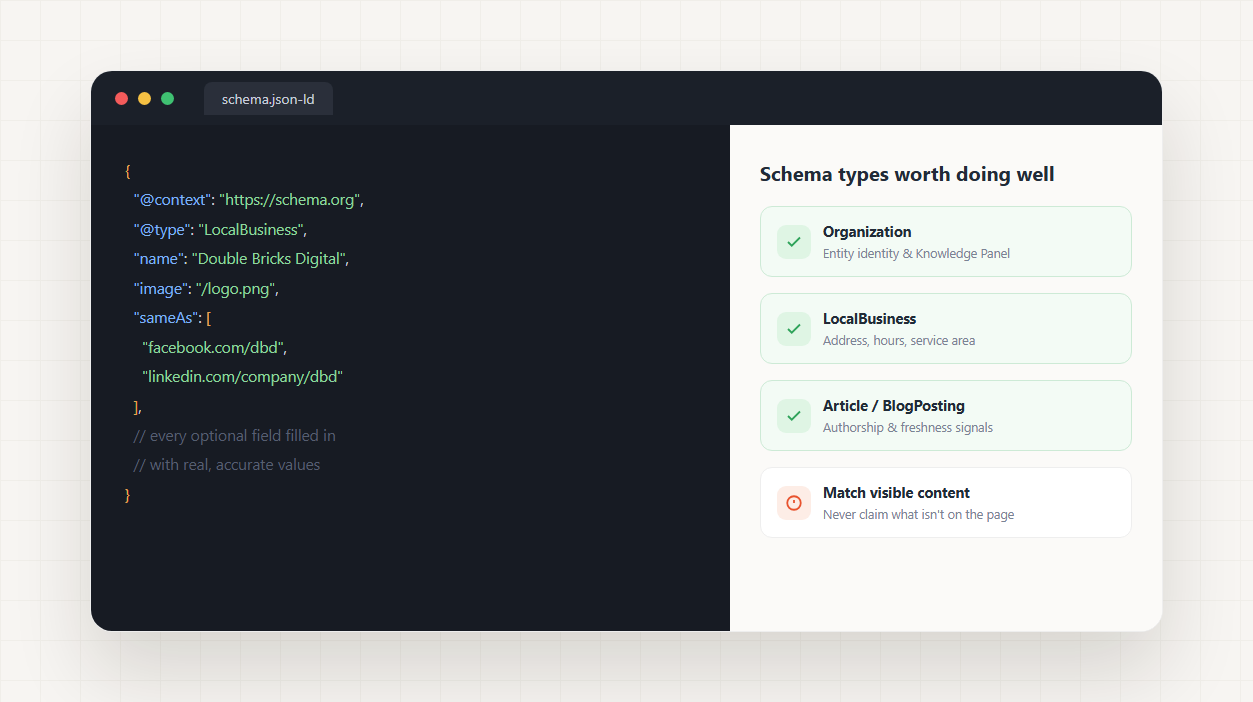
- Organization — Your business identity, logo, social profiles. Foundational — feeds Knowledge Panel and entity disambiguation.
- LocalBusiness (or a specific subtype) — Address, hours, service area. Essential for any business with a physical or service location.
- Article / BlogPosting — Blog and news content. Powers article rich results and signals authorship/freshness.
- FAQPage — Genuine Q&A content. No longer guarantees a rich result, but still useful structural context if the Q&A is real.
- Product / Review / AggregateRating — Ecommerce and service reviews. Star ratings remain one of the highest-CTR rich results available.
- BreadcrumbList — Site navigation structure. Helps both search engines and AI systems understand site architecture.
- HowTo — Step-by-step instructional content. Useful for genuinely procedural content, like the steps below.
The common failure mode isn't missing schema — it's boilerplate schema copied from a template with the minimum fields filled in. The optional properties (author, image, dateModified, sameAs) are what give search and AI systems enough context to trust the content, not just parse it.
How to Add Schema Markup to Your Website (Step by Step)
- Decide which type(s) apply to the page. A blog post needs Article; your homepage needs Organization; a location page needs LocalBusiness.
- Build the JSON-LD block. You can hand-write it (schema.org publishes the full property list) or generate a starting point with a tool, then fill in every field with real, accurate values — never leave placeholder text in a live page.
- Add it to the page. On Webflow, this goes in the page's custom code “head” or “before </body> tag” embed. On WordPress, most SEO plugins (Yoast, RankMath) have a schema module; a custom code snippet works if not. On Shopify, it's typically added via theme.liquid or a dedicated app.
- Match it exactly to what's visible on the page. This is a strict rule, not a suggestion — if your schema claims a 4.8-star rating and that number isn't visible anywhere on the rendered page, Google can flag it as spam. Content parity between schema and visible content is enforced.
- Validate before publishing (see the next section).
- Re-check after any redesign or CMS migration — schema is exactly the kind of thing that silently breaks when a template changes.
How to Test & Validate Your Schema
Before anything goes live, run it through:
- Google's Rich Results Test — confirms Google can parse it and shows which rich results it's eligible for.
- Schema.org's Validator — checks the code is technically valid, even for types that don't produce a Google rich result.
If you'd rather skip the manual checking, our free Schema Audit Tool will scan your site, tell you what schema is currently present, and flag what's missing or broken — it's the fastest way to see where you actually stand before investing time in a fix.
What Actually Moves the Needle for AI Citations
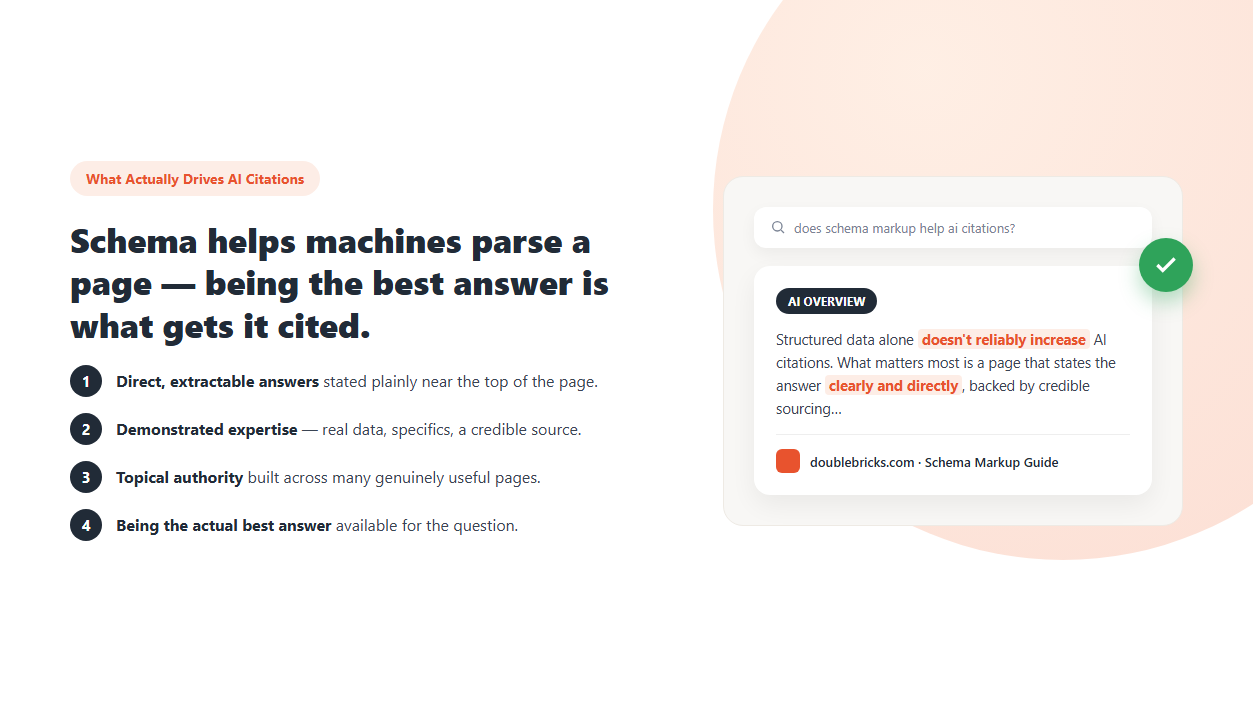
If schema alone isn't the lever, what is? Based on the research above and the broader pattern across AI search platforms, the strongest predictors of AI citation are:
- Direct, extractable answers. Content that states the answer plainly near the top of the page, rather than burying it in a narrative, gets picked up more reliably.
- Demonstrated expertise and sourcing. Citing real data, being specific instead of generic, and having a credible author or organisation behind the content.
- Topical authority. A body of genuinely useful content on a subject outperforms a single well-optimised page.
- Being the actual best answer available. This sounds obvious, but it's the one lever every piece of AI-search advice eventually circles back to.
We go deeper on the broader AEO/GEO shift — how AI search actually works and what it means for your content strategy — in a separate guide: Decoding AEO, SEO, GEO & LLM.
Common Schema Mistakes That Can Hurt You
- Copying another site's schema wholesale without updating every field to match your business
- Claiming ratings, prices, or availability that aren't actually visible on the page
- Using the generic Thing or LocalBusiness type when a more specific subtype exists
- Adding FAQPage schema to content that isn't genuinely a Q&A (padding a page with fake questions to chase a rich result)
- Never re-validating after a site redesign, so schema quietly breaks and goes unnoticed for months
Case Study: Getting Cited in an AI Overview
Schema is one input among many — content built specifically to answer a question directly is what tends to get picked up. One of our content clients, a flooring business, had a blog post engineered to answer a specific customer question directly rather than just chase a page-one ranking. Google's AI Overview now serves that post as its answer. The full approach behind it is covered in our AEO, SEO, GEO & LLM guide — worth reading alongside this one if AI visibility is a priority for your business.
Get Your Schema (and AI Visibility) Checked Properly
Double Bricks Digital works on both sides of this — the technical implementation (schema, site structure) through our Search Marketing (SEO/SEM) service, and the content built to actually earn citations through our Content Strategy & Production team. You can see examples of both in our case studies. Run your site through our free Schema Audit Tool first, or get in touch if you'd rather have a specialist look at it directly.
Frequently Asked Questions
Does schema markup guarantee I'll appear in AI Overviews or ChatGPT answers?
No. Based on the most rigorous available research, schema alone doesn't reliably move AI citation rates. It remains valuable for traditional rich results, entity clarity, and local search, and it's worth doing well — just not as a guaranteed AI citation shortcut.
Do I need schema markup on every page of my website?
No. Prioritise your homepage (Organization), any location pages (LocalBusiness), blog and article content (Article), and any page with genuine reviews or FAQs. Thin or low-value pages don't need it.
What's the difference between schema markup and SEO?
Schema markup is one technical component within SEO, not a separate discipline. It helps search engines parse your content correctly; it doesn't replace the content, keyword strategy, links, or authority-building that SEO also requires.
How do I know if my website already has schema markup?
Run your homepage and a few key pages through Google's Rich Results Test, or use our free Schema Audit Tool to check your whole site at once.